20 March 2026
Guide to Core Load Cell Classifications and Application Adaptation
Load cells can be classified in various ways based on their structure, working principle, and intended use. Structural classification is the most common method, as different designs vary significantly in geometry, loading methods, and precision performance. Selecting the precise match for your specific application is key to maximizing performance. Today, we will clarify the mainstream load cell structures to help you quickly identify the right type for your needs.
S-Type Load Cells: The Versatile Solution for Tension & Compression. The first type is the S-type load cell, named for its distinctive "S" shape. Its primary advantage is the ability to withstand both tension and compression forces.It offers moderate precision (typically OIML C3 grade), featuring flexible installation and a compact footprint.Its applications are extensive, including crane scales, tensile testing equipment, small hopper scales, and dynamic tension weighing in logistics sorting lines. It performs reliably in both static and light dynamic weighing environments.The spring element is usually made of alloy steel. For harsh environments, stainless steel versions are available, offering excellent cost-effectiveness.

Column Load Cells: The Robust Choice for High-Capacity Weighing.The second type is the Column Load Cell (sometimes called a Canister Load Cell). It features a cylindrical design with a rugged structure and exceptional overload resistance, capable of handling high capacities ranging from several tons to hundreds of tons.It can achieve high precision up to OIML C4 grade, making it ideal for static weighing applications.These are primarily used in large-scale industrial equipment, such as port weighbridges, truck scales, large hopper/silo weighing, and heavy-duty cargo measurement in metallurgy and mining industries.Its key characteristic is superior stability, allowing for long-term reliable operation in complex industrial environments with high resistance to damage from external impacts.
Shear Beam & Single Point Load Cells: The Standard for Commercial and Light Industrial Weighing. The third type is the Cantilever/Shear Beam Load Cell (often referred to as a Single Point Load Cell in smaller scales). It features a cantilever design where one end is fixed and the other end is subjected to the load. It offers high precision (typically OIML C3 to C4 grade) and is perfectly suited for small to medium-sized platform weighing applications.The most common applications include kitchen scales, commercial bench scales, and express/parcel scales. It is also ideal for weighing small hoppers and tanks. With its simple installation—requiring no complex mounting hardware—and low cost, it is the top choice for daily commercial and household weighing scenarios.

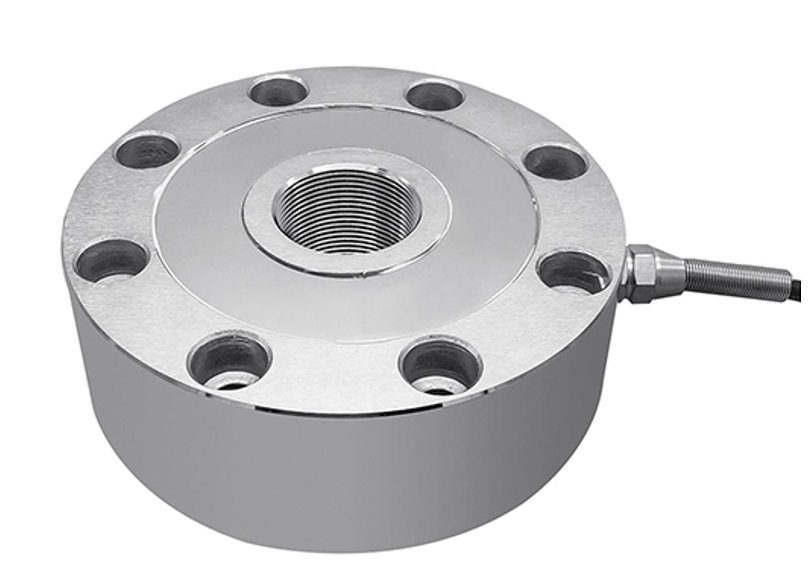
Spoke (Pancake) Load Cells: The Benchmark for High Precision & Eccentric Load ResistanceThe fourth type is the Spoke Load Cell (commonly known as a Pancake Load Cell). It features a compact, wheel-spoke design and offers exceptional resistance to eccentric (off-center) loading.It provides ultra-high precision, reaching up to OIML C6 grade, and is capable of withstanding significant axial pressure, making it ideal for high-precision weighing applications.These are primarily used in laboratory testing, precision metering equipment, medical devices (such as medical scales and wheelchair scales), and industrial weighing processes with stringent accuracy requirements.The core advantage lies in its minimal error and superior stability, effectively eliminating weighing deviations caused by uneven force distribution.
Beyond the four
mainstream types mentioned above, there are various specialized load cells
designed for niche applications. When selecting the ideal sensor, it is crucial
to consider not only the mechanical structure but also the capacity (tonnage),
accuracy requirements, and environmental conditions. Only through this holistic
approach can you achieve precise adaptation and high-efficiency performance.